Why Choosing the Right PTO Gearbox Matters More Than Choosing the Cheapest
A PTO gearbox is the single point where all tractor power concentrates before reaching your implement. Every horsepower the engine produces travels through a narrow chain of components — the PTO clutch, the driveline shaft, and then the gearbox — before it becomes useful work at the rotary cutter blade, the auger bit, or the baler roll. If the gearbox is underspecified, it becomes the weakest link in that chain. If it is over-specified, you pay for capacity you never use and add unnecessary weight to the implement frame. And if the mounting pattern, spline count, or rotation direction is wrong, the gearbox simply will not bolt onto your machine regardless of its torque rating.
The financial stakes extend well beyond the purchase price. A PTO gearbox that fails during peak harvest can idle a tractor and operator for days while a replacement is sourced, shipped, and installed — downtime that costs a commercial farmer or contractor far more per day than the gearbox itself. Choosing correctly the first time eliminates this risk entirely. This guide provides a systematic approach to PTO gearbox selection that covers every specification you need to verify before placing an order.

The 8-Point Specification Checklist
Before searching for a pto gearbox for sale, gather these eight parameters from your implement’s manual, the old gearbox nameplate, or by direct measurement. Missing even one can result in a return — and return shipping on a 25 kg cast iron gearbox is neither cheap nor fast.
1. PTO Speed — 540 or 1,000 RPM
This is the rotational speed of the tractor’s PTO stub shaft, which determines the input speed to the gearbox. Most compact and utility tractors up to 65 HP use a 540 RPM PTO with a 6-spline 1-3/8 in. stub. Larger tractors from 65 HP upward typically offer 1,000 RPM on a 21-spline 1-3/8 in. stub. Some modern tractors provide both speeds via a selectable PTO output. The gearbox you purchase must match the PTO speed your tractor delivers — not because the gears care about absolute input RPM, but because the gear ratio is designed to produce a specific output speed from the expected input speed. A gearbox designed for 540 RPM input that receives 1,000 RPM will overspeed the output shaft by 85%, potentially destroying the implement’s bearings and exceeding the safe operating speed of blades, augers, or rollers.
2. Gear Ratio
The gear ratio determines the output speed and torque relative to the input. A 1.47:1 ratio on a 540 RPM input produces 367 RPM output and multiplies the input torque by 1.47. A 1.93:1 ratio on the same input produces 280 RPM output with 1.93× the torque. The correct ratio for your implement is not optional — it is an engineering specification determined by the implement designer to match blade tip speed, auger penetration rate, or roll surface velocity requirements. Installing a gearbox with the wrong ratio either overdrives the implement (causing excessive wear and safety hazards) or underdrives it (causing poor performance and engine overloading). If the original gearbox nameplate is unreadable, count the teeth on both the input and output gears: ratio = output gear teeth ÷ input gear teeth.
3. Horsepower and Torque Rating
Gearbox manufacturers publish two ratings: maximum input horsepower and continuous output torque. The horsepower rating tells you the maximum engine power the gearbox can handle at its design input speed — it is a function of torque × RPM, so a gearbox rated at “75 HP at 540 RPM” handles a different torque than “75 HP at 1,000 RPM” (the 540 RPM version handles nearly double the torque for the same horsepower). Always verify the torque rating at the specific ratio and input speed you intend to use. For applications with shock loading — rotary cutters hitting stumps, post hole diggers striking rock — apply a service factor of 2.0 to 2.5× the nominal calculated torque when selecting the gearbox rating.
4. Mounting Pattern (Bolt Circle)
The mounting pattern is the arrangement of bolt holes on the gearbox mounting flange that allows it to attach to the implement frame. Common patterns include 4-bolt square, 4-bolt rectangular, and 6-bolt circular configurations. The critical dimensions are the bolt circle diameter (BCD), the number of holes, the bolt hole diameter, and the pilot bore diameter (the center locating hole that ensures concentricity between the gearbox and the implement). Even if two gearboxes have identical performance specifications, they will not interchange if their mounting patterns differ by as little as 3 mm in bolt hole position.
5. Input Shaft Configuration
The input shaft connects to the PTO driveline shaft via a splined coupling. Verify three things: spline count (6 or 21), shaft diameter (1-3/8 in. or 1-3/4 in.), and shaft length (the exposed portion that enters the driveline yoke). A 6-spline input shaft does not fit a 21-spline driveline yoke, and a shaft that is too short fails to engage the full spline length, causing localized stress concentration and accelerated spline wear.
6. Output Shaft Configuration
The output shaft transmits power from the gearbox to the implement’s working mechanism. Verify the output shaft diameter, spline or keyway dimensions, rotation direction (clockwise or counterclockwise when viewed from the output end), and any thread or retaining bolt pattern on the shaft end. Right-angle gearboxes can produce either clockwise or counterclockwise output rotation depending on the spiral direction of the bevel gears — and most implements are designed for one direction only. A reverse-rotation gearbox on a rotary cutter would spin the blades backward, producing no cutting action and creating a debris ejection pattern directed toward the operator.
7. Gearbox Configuration — Right-Angle or Inline
Right-angle gearboxes redirect the power axis by 90 degrees and are standard on rotary cutters, tillers, and post hole diggers where the PTO shaft is horizontal but the implement mechanism needs vertical or lateral rotation. Inline (parallel-shaft) gearboxes maintain the same axis between input and output and are common on round balers, feed mixers, and pump drives. The distinction is fundamental — you cannot substitute one for the other without completely redesigning the implement mounting.
8. Oil Capacity and Fill Position
Although oil capacity seems like a minor specification, it determines the gearbox’s thermal capacity and lubrication adequacy. A replacement gearbox with a smaller oil capacity than the original may overheat under the same operating conditions because it has less thermal mass to absorb heat between cooling intervals. Verify that the fill plug, drain plug, and vent positions are compatible with your implement’s frame — a fill plug that ends up blocked by the implement structure makes routine oil checks impossible without partial disassembly.
| Espisipikasyon | Where to Find It | Consequence If Wrong |
|---|---|---|
| Katulin sa PTO | Tractor operator’s manual or PTO stub markings | Output overspeed → implement damage, safety hazard |
| Ratio sa gear | Old gearbox nameplate or tooth count | Wrong output speed → poor performance or overload |
| HP / torque rating | Old gearbox nameplate or implement manual | Undersized → premature failure; oversized → condensation corrosion |
| Mounting pattern | Measure bolt positions on implement frame | Does not physically bolt on → immediate return |
| Input spline | Count ridges on old input shaft or check PTO stub | Does not connect to driveline → incompatible |
| Output shaft | Measure diameter, keyway, and rotation direction | Wrong rotation → implement runs backward; wrong diameter → no fit |
| Pag-configure | Visual inspection of implement layout | Right-angle vs. inline mismatch → cannot install |
| Oil capacity / plugs | Old gearbox manual or measure fill volume | Thermal capacity mismatch → overheating; blocked plugs → neglected maintenance |
OEM vs. Aftermarket: What You Are Actually Paying For
When a gearbox fails, the implement dealer’s first recommendation is almost always the OEM replacement — the exact part number from the implement manufacturer. This is the safest option from a compatibility standpoint because the part is guaranteed to match the original in every dimension, rating, and mounting detail. It is also, consistently, the most expensive option — OEM gearboxes carry price premiums of 40% to 120% over comparable aftermarket units because the implement manufacturer must recover their engineering, inventory, and distribution costs through the replacement parts channel.
Aftermarket gearboxes fall into two distinct categories that buyers must differentiate: direct-replacement units and generic units. A direct-replacement aftermarket gearbox is engineered to match a specific OEM part number in all eight specification parameters listed above. The housing dimensions, bolt pattern, shaft configurations, and gear ratio replicate the OEM design — the only differences are typically the brand name cast into the housing and, potentially, the metallurgical specifications of the gears and bearings. A reputable aftermarket manufacturer publishes a cross-reference table that maps their part numbers to the OEM numbers they replace, and provides dimensional drawings with tolerances so the buyer can verify compatibility before ordering.
Generic aftermarket gearboxes are sold by general specifications — “75 HP right-angle gearbox, 1.5:1 ratio, 540 RPM input” — without reference to a specific OEM replacement. These units are less expensive but carry higher compatibility risk because the mounting pattern, shaft dimensions, and rotation direction may not match your implement. Generic gearboxes are appropriate for custom-built implements, prototype equipment, or situations where the buyer has the fabrication capability to modify the implement mounting to fit the available gearbox. For production farm equipment where downtime costs money, direct-replacement units are worth the modest premium over generics.

Heavy-duty XL series PTO gearbox — a direct-replacement aftermarket unit engineered to OEM interchange specifications
Price Factors: What Drives the Cost of a PTO Gearbox
Understanding what makes one PTO gearbox cost twice as much as another — when both claim the same horsepower rating — helps you make an informed purchasing decision rather than simply choosing the lowest-priced option and hoping for the best.
Gear material and heat treatment. The gear teeth are the most stressed components in any pto gearbox. Economy units use through-hardened medium-carbon steel (typically AISI 4140 or 4340) with a surface hardness of 28–34 HRC. This provides adequate wear resistance for intermittent, low-shock applications but is vulnerable to surface pitting under sustained heavy loads. Premium units use carburized alloy steel (typically AISI 8620 or 9310) case-hardened to 58–62 HRC on the tooth surfaces while maintaining a tough, ductile core at 30–38 HRC. The hard surface resists pitting and abrasion; the tough core absorbs shock loads without cracking. Carburizing adds a separate furnace cycle and grinding operation to the manufacturing process, which is why case-hardened gearboxes cost 30% to 50% more than through-hardened alternatives at the same physical dimensions.
Bearing quality. Bearings account for 15% to 25% of a gearbox’s manufacturing cost. Economy gearboxes use domestically sourced bearings from regional manufacturers whose quality control may be inconsistent between production batches. Premium gearboxes specify bearings from tier-one manufacturers whose products meet ISO 492 dimensional tolerances and are individually tested for noise, vibration, and endplay before shipment. The practical difference manifests as bearing life: a tier-one tapered roller bearing rated at L10 = 5,000 hours delivers that life consistently across thousands of production units. A lower-tier bearing with the same nominal rating may achieve 5,000 hours on the best sample and fail at 1,200 hours on the worst — a variance that makes equipment reliability planning impossible.
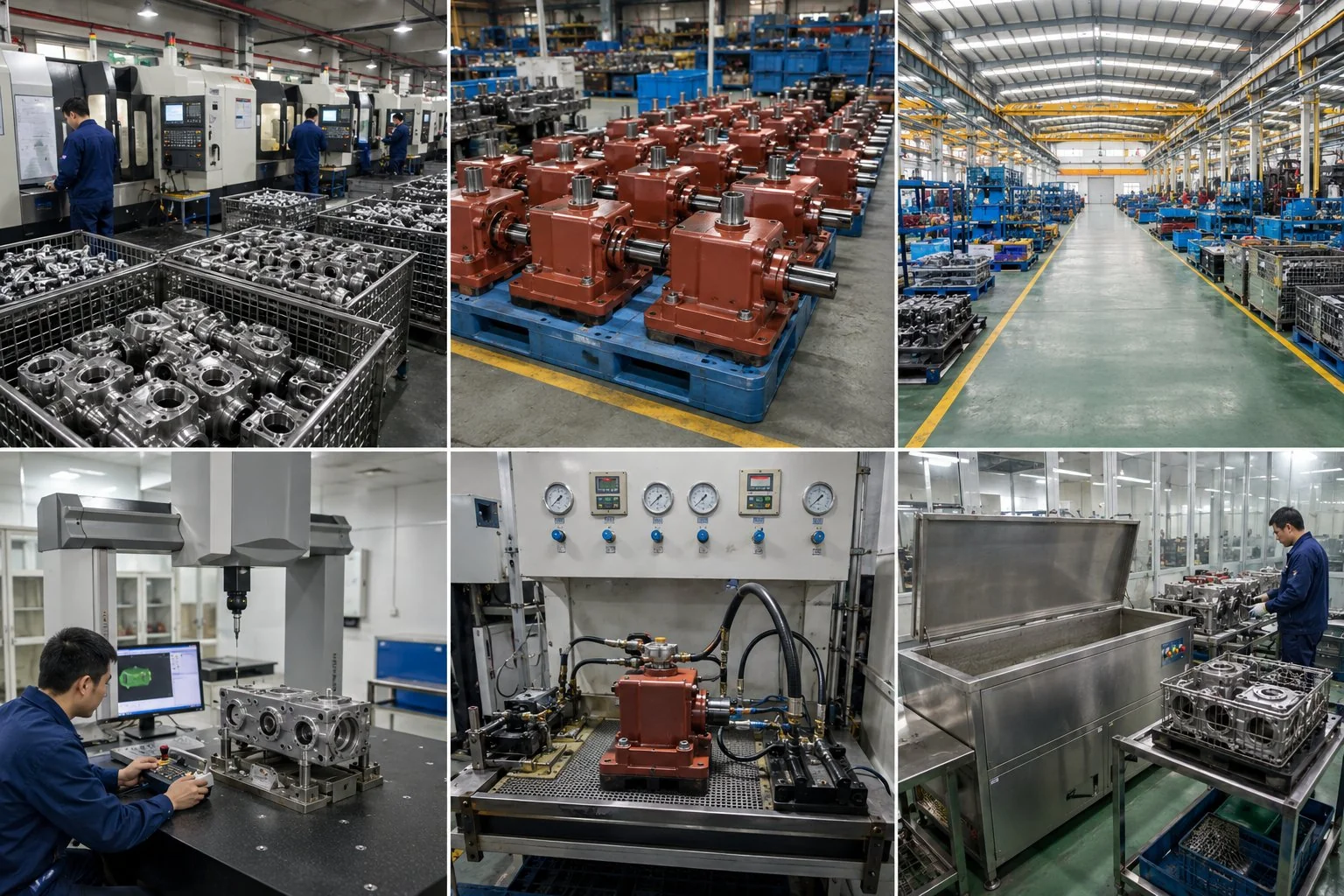
Housing casting quality. A gearbox housing positions the bearings that support the gears — if the bearing bore locations are inaccurate, the gear teeth contact unevenly across their face width, causing localized overloading, noise, and accelerated wear. Premium housings are machined on CNC boring mills that hold bearing bore position and diameter to within ±0.015 mm across the entire housing. Economy housings machined on less precise equipment may allow ±0.05 mm or greater variation, which is sufficient to cause audible gear whine and measurable reduction in gear tooth life.
Seal technology. The shaft seals keep lubricant inside the housing and contaminants outside. A single-lip nitrile seal costs about $2 and provides adequate sealing in clean, indoor environments. An gearbox sa agrikultura operates in dust, mud, crop debris, and temperature extremes that demand double-lip seals with external dirt excluders — which cost $8 to $15 each but provide reliable sealing for 2,000+ operating hours. The seal choice alone can determine whether the gearbox lasts for a decade of seasonal use or fails within two seasons from oil loss and contaminant ingress.
Application-Based Selection Guide
Rather than browsing gearbox catalogs by horsepower rating alone, experienced buyers start from their implement type and work backward to the gearbox specification. Different implement categories impose fundamentally different demands on the gearbox — a 50 HP rotary cutter gearbox and a 50 HP round baler gearbox are not interchangeable even though they share the same nominal power rating.
🔪
Rotary Cutters & Mowers
Right-angle configuration. Ratios 1.47:1 to 1.93:1. High shock load tolerance. Heavy-duty output shaft for blade carrier. Cast iron housing. Service factor ≥ 2.0. Typical range: 25–100 HP.
🌿
Rotary Tillers
Right-angle or T-configuration. Ratios 1.6:1 to 2.5:1. Multiple output shafts possible for side-drive configurations. High continuous torque in compacted soil. Range: 15–80 HP.
🎯
Post Hole Diggers
Right-angle, vertical output. Ratios 2.7:1 to 4.15:1. Severe intermittent shock from rock strikes. Shear pin or slip clutch protection. Structural load-bearing housing. Range: 15–90 HP.
💧
Mga Hydraulic Bomba Drive
Inline or right-angle speed increaser. Ratios 1:2 to 1:6. Continuous-duty rated. High-speed output bearings and PTFE seals. SAE pump mounting flange. Range: 10–75 HP.
How to Measure a Failed Gearbox for Replacement
When the nameplate is corroded beyond reading and the implement manual has long disappeared, direct measurement of the failed gearbox is the only reliable method for obtaining replacement specifications. Here is a systematic measurement procedure that captures every critical dimension.
Start with the mounting flange. Place the gearbox on a flat surface with the mounting flange facing up. Measure the center-to-center distance between diagonal mounting bolt holes — this is the bolt circle diameter (BCD). Record the number of bolt holes, the diameter of each hole, and the pilot bore diameter in the center of the flange. Photograph the flange with a ruler or tape measure visible for scale — this photograph serves as a verification document when the supplier confirms compatibility.
Next, measure the input shaft. Count the spline ridges by marking one ridge with a paint pen and counting around the circumference. Measure the shaft outside diameter across the spline tips with a caliper. Record the exposed shaft length from the face of the housing to the end of the shaft — this is the engagement length that must match the driveline yoke depth.
Then measure the output shaft. Record the shaft diameter at the exit point from the housing, the keyway width and depth (if present), and the total exposed shaft length. If the output shaft has splines rather than a keyway, count the splines and measure the major and minor diameters. Determine the rotation direction by slowly turning the input shaft by hand and noting which direction the output shaft rotates — mark this clearly as “CW” or “CCW” when viewed from the output end.
Finally, count the gear teeth. If the gearbox housing can be opened (remove the inspection cover or split the housing halves), count the teeth on both the input gear and the output gear. The ratio is output teeth ÷ input teeth. If the housing cannot be opened, rotate the input shaft exactly one full revolution while counting how many partial revolutions the output shaft completes — the inverse of this count is your gear ratio. For example, if one full input revolution produces 0.67 output revolutions, the ratio is 1 ÷ 0.67 = 1.49:1.
Evaluating Warranty and Supplier Reliability
A warranty is only as valuable as the supplier’s ability and willingness to honor it. When shopping for a pto gearbox for sale, compare warranty terms across suppliers and pay attention to the exclusions — not just the coverage period. A 24-month warranty that excludes “damage from impact loading” is meaningless on a rotary cutter gearbox, because impact loading is the normal operating condition. Look for warranties that specifically cover the application you describe when ordering, and confirm the warranty terms in writing before purchase.
Supplier reliability matters beyond warranty claims. Evaluate three factors before committing to a new supplier. First, inventory availability: can they ship the unit within your required timeframe, or are they quoting a lead time that will leave your implement idle for weeks? A manufacturer with deep inventory of common agricultural gearbox models — as maintained by the Kanunay nga Gahum nga PTO Gearbox facility — can ship standard replacement units within 3 to 5 business days, while a supplier who builds to order may need 4 to 8 weeks. Second, technical support: will a knowledgeable engineer help you verify compatibility before ordering, or are you left to match specifications on your own? Third, return policy: if the gearbox does not fit despite your best specification efforts, what is the return process and who bears the return shipping cost? Kontaka ang among team sa inhenyeriya to discuss your specific requirements and verify compatibility before placing an order.
Price-only comparisons between suppliers are a false economy. A gearbox that costs 25% less but arrives with a mismatched mounting pattern costs you the return shipping, the re-order wait time, and the additional implement downtime — expenses that typically exceed the original price difference several times over.
Installation Verification Before First Operation
After the replacement PTO gearbox arrives and before you bolt it onto the implement, perform five verification checks that take less than 15 minutes and can prevent costly errors.
First, offer up the gearbox to the implement mounting without tightening any bolts. Verify that all mounting holes align and that the pilot bore seats fully into the implement’s locating bore. If any hole is misaligned by more than 1 mm, stop — do not elongate holes to force a fit, as this removes the pilot bore’s centering function and allows the gearbox to shift under load, causing rapid gear wear from misalignment.
Second, slide the driveline yoke onto the input shaft spline by hand. It should engage smoothly with minimal lateral play. Excessive play (more than 0.3 mm side-to-side) indicates worn splines on either the shaft or the yoke — determine which component is worn and replace it before operating, as a loose spline connection accelerates wear exponentially.
Third, turn the input shaft by hand through several complete revolutions while a helper observes the output shaft. The output should rotate smoothly in the correct direction with no binding, clicking, or rough spots. Any irregularity at no load indicates an internal problem — assembly error, shipping damage, or a manufacturing defect — that will worsen rapidly under power.
Fourth, check the oil level through the fill plug. New gearboxes are sometimes shipped without oil to prevent leakage during transit, and operating a dry gearbox for even 30 seconds under load will score the gear teeth and overheat the bearings beyond recovery. Fill with the specified EP gear oil to the correct level (typically the bottom of the fill plug hole when the gearbox is in its operating orientation) before the first start.
Fifth, torque all mounting bolts to the manufacturer’s specification using a calibrated torque wrench. Over-tightened bolts can distort the housing, shifting the bearing bores out of alignment. Under-tightened bolts allow the gearbox to shift under load, creating cyclic stress on the bolt holes that leads to housing cracks. The correct torque value is a precision specification, not an invitation to apply maximum force with an impact wrench.
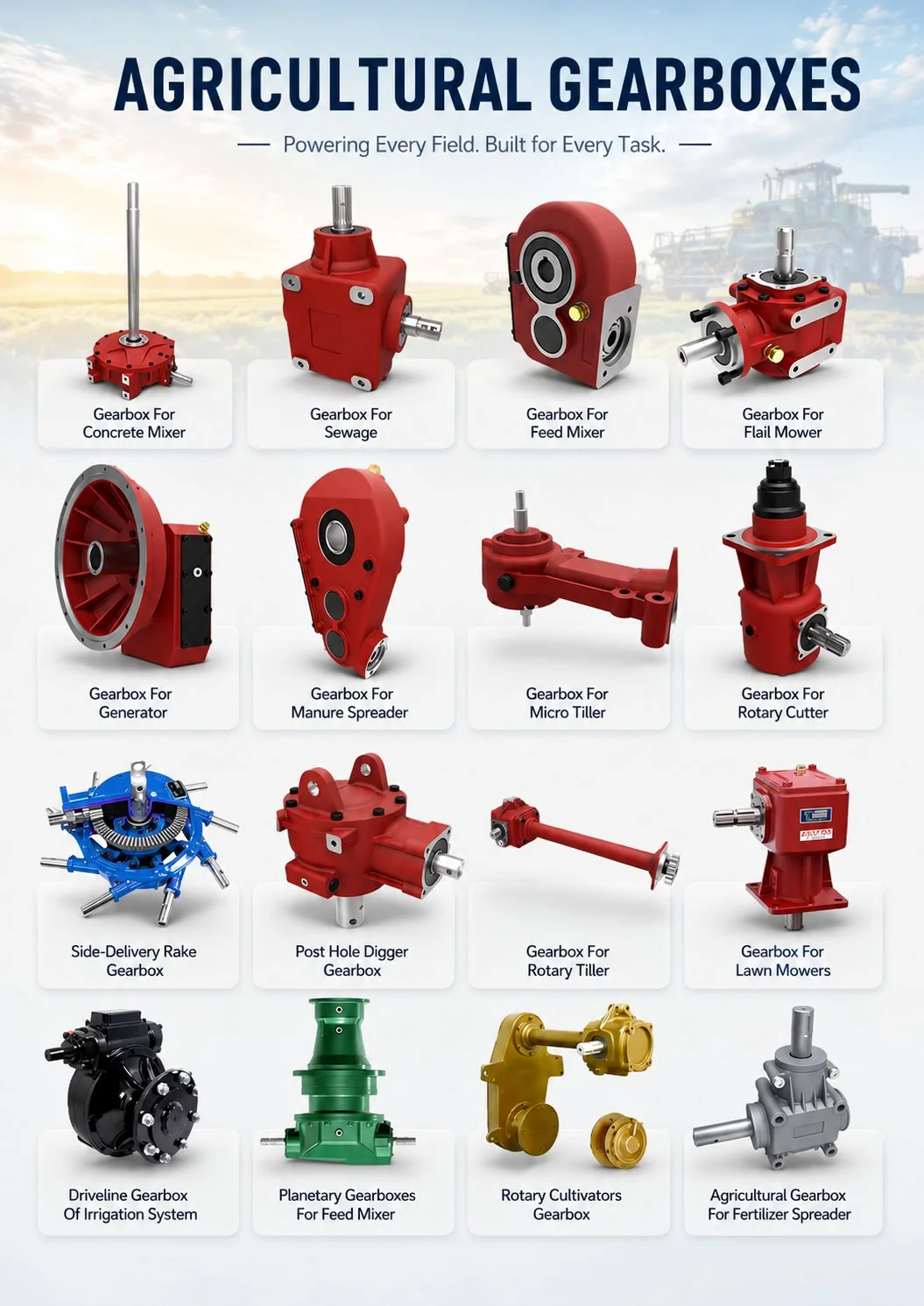
Multiple PTO gearbox configurations — right-angle, inline, and speed increaser types available for different implement requirements
Mga Kanunayng Gipangutana nga Pangutana
Ready to Order? Send Us Your Gearbox Specifications
Share your old gearbox nameplate data, implement model, or dimensional measurements — our engineering team will cross-reference to the correct replacement part number, verify compatibility, and provide a delivered-price quotation within 24 hours. Over 500 PTO gearbox models in stock.
Editor: Cxm