Gray Cast Iron: The Economy Standard
Gray cast iron (ASTM A48, grades 30–40) is the most widely used gearbox housing material in the agricultural equipment industry. Its popularity is driven by three factors: low casting cost (gray iron flows well in the mold, fills complex shapes reliably, and requires minimal gating and risering), excellent machinability (the graphite flakes in gray iron act as chip breakers and internal lubricant, reducing cutting tool wear and machining time by 20–30% compared to ductile iron), and good vibration damping (the same graphite flake structure that makes gray iron brittle also absorbs vibrational energy, reducing gear mesh noise transmitted through the housing to the implement frame).
The fundamental limitation of gray cast iron is its brittleness. The graphite flakes that provide damping and machinability also act as internal stress concentrators — sharp-edged discontinuities in the iron matrix that initiate cracks under impact or tensile loading. Gray iron has essentially zero elongation at fracture (less than 0.5%), meaning it cracks without any visible deformation warning. In agricultural service, where the gearbox is routinely subjected to rock strikes, frozen-material impacts, implement tip-overs, and accidental contact with fixed objects, this brittleness means that a single severe impact can crack the housing — and a cracked housing is almost always an irreparable write-off that scraps the entire gearbox assembly including the gears and bearings inside.
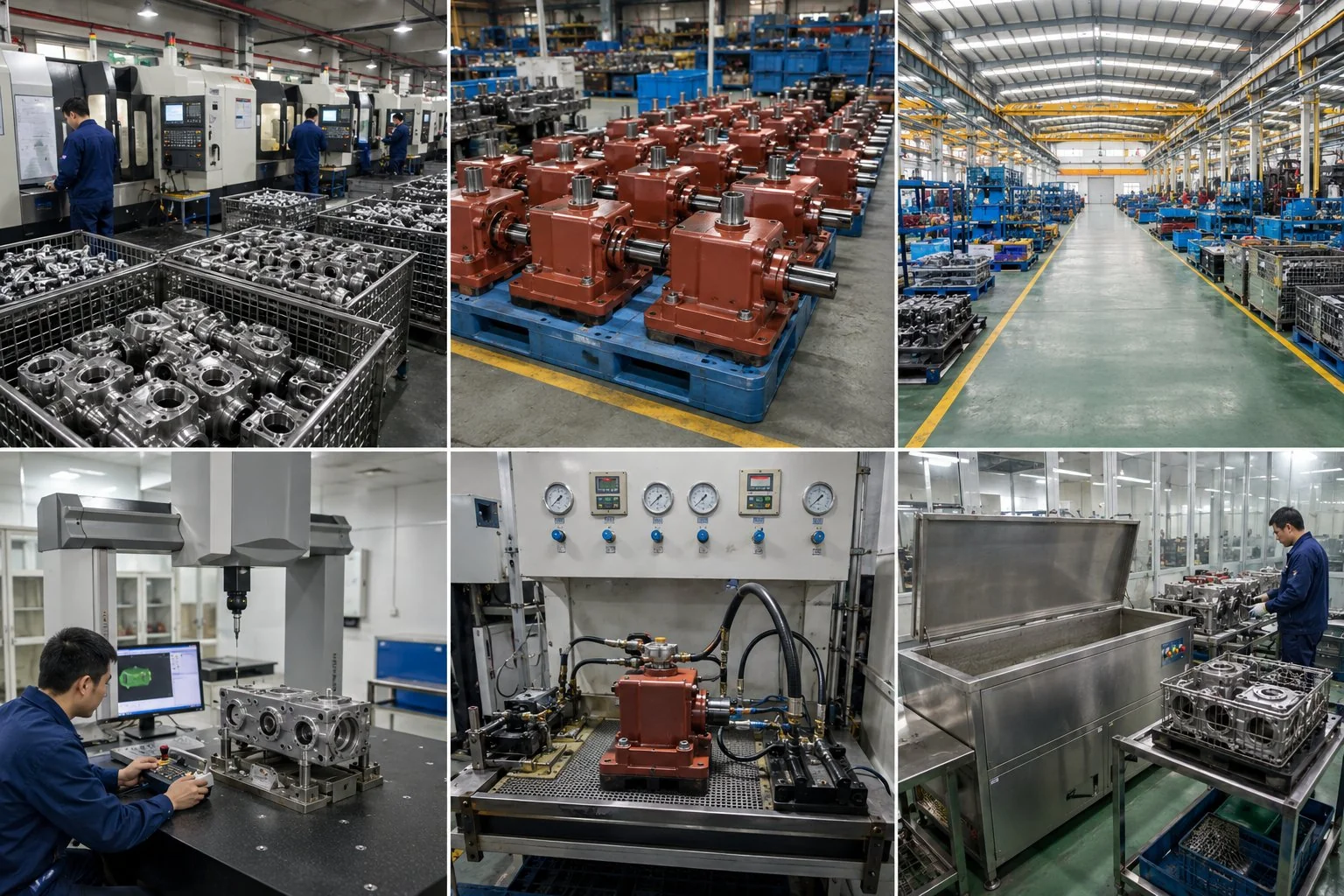
Ductile (Nodular) Cast Iron: The Professional Choice
Ductile cast iron (ASTM A536, grades 65-45-12 through 100-70-03) transforms the graphite flake structure of gray iron into spheroidal (nodular) graphite through the addition of magnesium or cerium during the melting process. This seemingly small metallurgical change produces dramatic improvements in mechanical properties: tensile strength increases by 50 to 100 percent, elongation at fracture increases from near-zero to 2 to 18 percent (depending on grade), and impact energy absorption increases by approximately three times compared to equivalent-grade gray iron.
Ductile Iron Impact Advantage
3× More
Impact energy absorption before cracking compared to gray cast iron
The difference between a survivable rock strike and a destroyed gearbox
For agricultural gearbox housings, the practical consequence of ductile iron’s toughness is clear: a rock strike, frozen-material impact, or accidental collision that would crack a gray iron housing typically dents or deforms a ductile iron housing without fracturing it. The gearbox may need a seal replacement and cosmetic attention, but the housing remains structurally intact and the internal components (gears and bearings) continue to operate in their original alignment. This impact survivability makes ductile iron the engineering-justified choice for any PTO gearbox used in field applications where impact events are likely — which encompasses virtually all agricultural implements including rotary cutters, tillers, balers, and mowers.
The cost premium for ductile iron over gray iron is typically 20 to 30 percent at the casting stage. This premium reflects the additional cost of the nodularizing treatment (magnesium addition), the slightly more complex melting and pouring process, and the reduced machinability (ductile iron requires harder cutting tools and slightly longer machining cycles than gray iron). However, the 20–30% housing cost premium translates to only a 5–10% increase in the total gearbox price because the housing is only one component of the assembly. For the protection it provides against catastrophic housing fracture, this modest premium is one of the most cost-effective investments in the entire gearbox specification. For insights on how housing quality affects gearbox acoustics, see our guide on gearbox noise and vibration diagnostics.
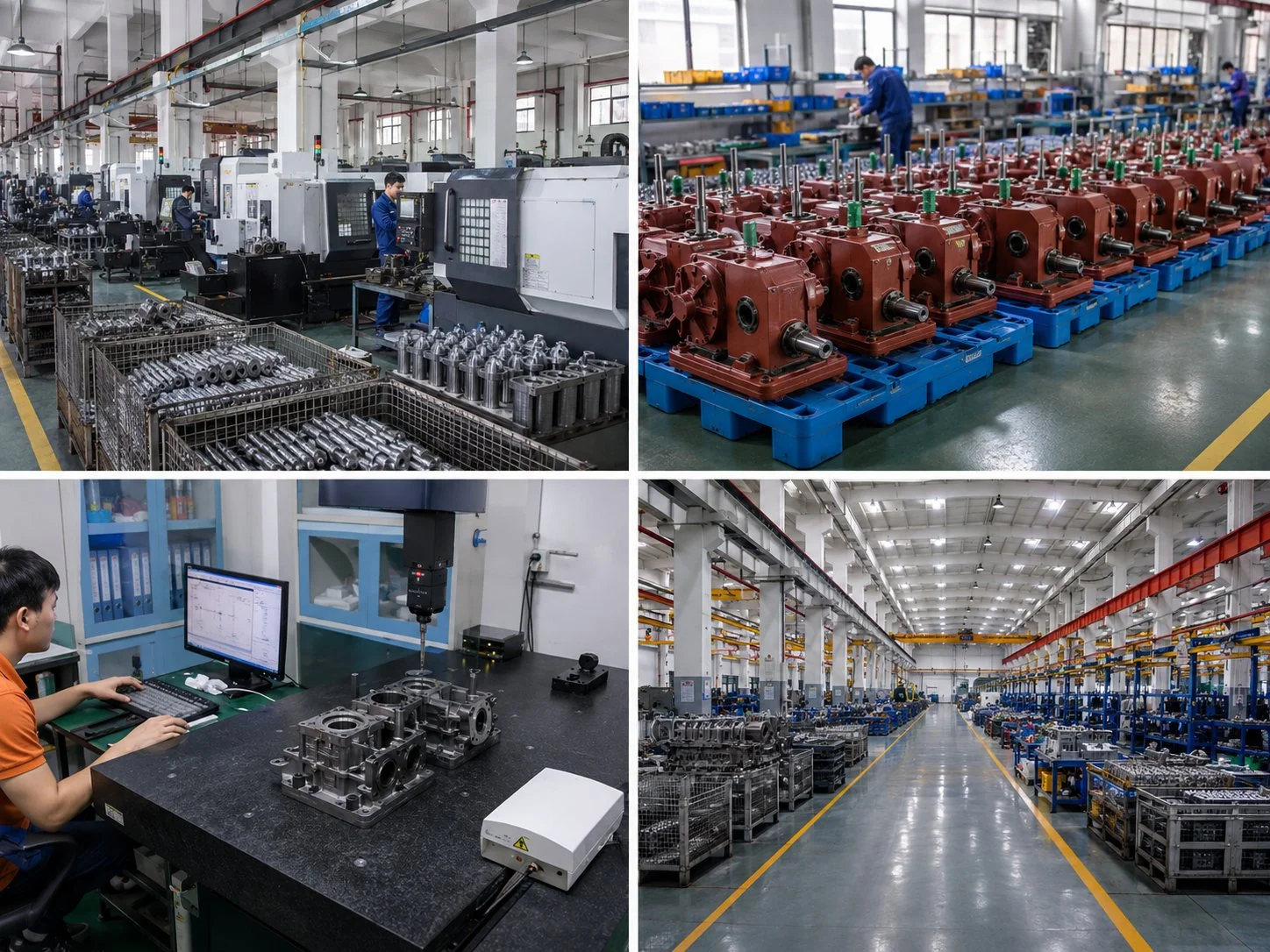
Precision machining of gearbox housings — bore alignment, surface finish, and flatness directly determine bearing life and gear mesh accuracy
Cast Steel and Aluminum: Specialized Applications
Cast steel housings (ASTM A27 or equivalent) offer the highest strength and toughness of any gearbox housing material — tensile strengths of 450 to 600+ MPa with elongation of 18 to 25 percent. Cast steel can absorb severe impacts without fracture and withstands fatigue loading that would eventually crack even ductile iron after extended service. However, cast steel is significantly more expensive to produce than either gray or ductile iron: higher melting temperature increases energy costs, lower fluidity requires more complex gating systems, greater shrinkage demands larger risers and more precise mold design, and the much harder material increases machining time and cutting tool consumption by 40 to 60 percent compared to gray iron.
Cast steel gearbox housings are justified only for extreme-duty applications where the impact severity and frequency exceed ductile iron’s capacity — mining equipment, heavy construction machinery, and some military vehicle drives. For agricultural PTO gearbox applications, ductile iron provides adequate impact resistance at a fraction of the cost, and cast steel housings are rarely specified.
Gray Cast Iron
Lowest cost. Best machinability and vibration damping. Brittle — cracks on impact without warning. Suitable for light-duty, low-impact applications only.
Ductile Cast Iron
3× impact resistance vs. gray iron. Good machinability. 20–30% housing cost premium. The professional standard for agricultural PTO gearboxes.
Cast Steel
Highest strength and toughness. Significantly more expensive. Justified only for extreme-duty applications beyond agricultural service levels.
Aluminum
Lightest weight (65% less than iron). Excellent corrosion resistance. Low stiffness limits gear precision. Suitable for light-duty, weight-sensitive applications only.
Aluminum housings (A356 or similar casting alloys) offer one-third the weight of equivalent iron castings and excellent corrosion resistance, but their lower elastic modulus (70 GPa vs. 170 GPa for iron) means the housing deflects more under load, potentially allowing bearing bores to shift out of alignment and degrading gear mesh accuracy. Aluminum housings are used in some lightweight industrial speed reducers, lawn and garden equipment, and marine gearboxes where weight savings and corrosion resistance are priorities. For heavy-duty agricultural PTO gearboxes where stiffness, impact resistance, and bearing bore stability are critical, aluminum is generally not recommended.
Casting Quality Indicators: What to Look for in a Housing
The quality of the casting process affects the housing’s mechanical properties as much as the material grade itself. A poorly cast ductile iron housing with porosity, sand inclusions, and cold-shut defects can perform worse than a well-cast gray iron housing of equivalent wall thickness. Identifying casting quality requires understanding the indicators visible on the finished housing surface and the documentation that a responsible manufacturer provides.
External surface quality reveals casting process control. A quality casting has uniform wall thickness (no thin spots where the core shifted during pouring), smooth parting line flash (cleanly trimmed without deep grinding marks that remove material from the structural wall), and no visible porosity or sand inclusions on machined surfaces. The bearing bore surfaces — the most critical machined features on the housing — should be mirror-smooth (Ra 0.8 to 1.6 micrometers) with no visible pitting, porosity, or tool marks. Any defect on a bearing bore surface creates a stress concentration that can initiate a fatigue crack in the bearing outer race, leading to premature bearing failure.
A quality manufacturer like Ever-Power PTO Gearbox provides material certificates documenting the iron grade, chemical composition, and mechanical properties of each casting batch. Contact our team for detailed housing material specifications on any gearbox model. For complete PTO shaft and agricultural gearbox solutions with verified housing quality, our engineering team provides full metallurgical documentation upon request.

Surface Protection: Coatings and Corrosion Prevention
Cast iron gearbox housings require surface protection against corrosion in agricultural environments where moisture, fertilizer chemicals, herbicide overspray, and animal waste create aggressively corrosive conditions. The standard protective coating for agricultural PTO gearbox housings is industrial acrylic or alkyd paint, applied after machining and assembly. Standard paint provides adequate protection for general field use with an expected coating life of 3 to 5 years before significant degradation requires touch-up.
For more demanding environments — sprayer-mounted gearboxes exposed to chemical overspray, gearboxes used in livestock operations where ammonia and organic acid exposure is continuous, or marine and coastal installations where salt spray accelerates corrosion — epoxy or polyester powder coating provides substantially superior protection. Powder coating creates a 60 to 120 micrometer film that is more uniform, harder, and more chemically resistant than wet-applied paint. The coating is applied electrostatically and cured at 180 to 200 degrees Celsius, creating a bonded finish that resists chipping, scratching, and chemical attack far better than paint. The cost premium for powder coating over standard paint is typically 5 to 15 percent of the housing cost — a modest investment for environments where corrosion would otherwise penetrate the housing wall within 3 to 5 years.
Internal corrosion protection is provided by the gear oil itself — the oil film on all internal surfaces prevents moisture contact with the iron substrate. This is why post-season oil changes are important: contaminated oil with suspended water provides poor corrosion protection during extended winter storage, while fresh oil with corrosion-inhibiting additives protects all internal surfaces throughout the off-season. For gearboxes stored in unheated buildings where condensation cycles are frequent, filling the gearbox to the top of the housing (rather than the normal operating level) during storage ensures that all internal surfaces remain oil-wetted and protected.
Housing Joint Design: Keeping the Oil In and the Dirt Out
The housing joint — the parting line where the main housing body meets the cover or cap — is a critical sealing surface that must contain pressurized oil splash, prevent oil leakage, and exclude external contaminants. The quality of the joint surface directly affects sealing effectiveness and the probability of oil leaks over the gearbox’s service life.
Premium gearboxes have machined joint faces — flat-milled or ground to a surface flatness of 0.05 mm or better across the full joint width. These machined surfaces seal effectively with a thin application of anaerobic gasket sealant (Loctite 518 or equivalent) without the need for a cut gasket. The sealant fills microscopic surface irregularities and cures to form a thin, flexible seal that maintains its integrity through thermal cycling and vibration. Economy gearboxes may use as-cast joint faces with only localized machining around bolt holes — these rougher surfaces require thicker gaskets to compensate for the casting surface irregularities, and the gaskets are more prone to creep and leakage over time as the bolt clamping force relaxes.
Bolt pattern density on the housing joint also affects sealing: closely spaced bolts (60 to 80 mm spacing) maintain uniform clamping pressure across the entire joint face, while widely spaced bolts (120+ mm spacing) allow the joint face to bow outward between bolt positions under internal oil pressure, creating potential leak paths. For agricultural gearbox applications where oil leaks attract dust, debris, and operator attention (and indicate seal degradation that allows contaminant ingress), a well-designed housing joint is not a cosmetic detail — it is a functional requirement for maintaining the internal cleanliness that protects bearing and gear life.
Frequently Asked Questions
Optimize Your Power Transmission
Every PTO gearbox we manufacture uses documented housing material with verified mechanical properties — ductile iron standard on all medium and heavy-duty models. Material certificates, casting inspection records, and machining dimensional reports available upon request. Specify with confidence.