How a Center-Pivot Irrigation Gearbox Works
A center-pivot irrigation system is essentially a long pipe supported by wheeled towers that rotate slowly around a fixed center point, spraying water as the span sweeps a circular field. Each tower is driven independently by a small electric motor (typically 0.37 to 1.5 kW) connected to a high-ratio irrigation gearbox that reduces motor speed by ratios of 40:1 to 60:1. The gearbox output shaft connects to the tower wheel through a direct drive or chain final drive, rotating the wheel at approximately 0.5 to 2.5 RPM — slow enough that the outermost tower advances at roughly 3 to 4 meters per minute.
This extreme speed reduction means the irrigation gearbox must multiply torque dramatically. A 1 kW motor spinning at 1,450 RPM and driving through a 50:1 worm gearbox delivers approximately 330 N·m of output torque — enough to move a tower supporting several hundred kilograms of pipe and water load across soft, uneven, and often muddy terrain. The gearbox must deliver this torque continuously for 12 to 20 hours per day throughout the irrigation season, often for 10 to 15 years before replacement, making thermal management and bearing life the two dominant engineering challenges.

Gear Types Used in Irrigation Gearboxes
Three gear configurations dominate the irrigation gearbox market, each with distinct performance characteristics that suit different operating conditions and budget constraints.
🔩
Worm Gear
Most common type. Achieves 40:1–60:1 ratio in a single stage. Self-locking under load (tower holds position when motor stops). Efficiency 35–65% depending on ratio and lubrication. Heat generation from sliding contact limits continuous duty in hot climates without adequate oil cooling.
⚙️
Helical-Worm Combination
A helical first stage reduces speed before the worm stage, allowing a smaller worm to run at lower sliding velocity. Efficiency improves to 50–70%. Reduced heat generation extends lubricant life and bearing life in continuous-duty applications. Slightly higher cost than single-stage worm units.
🛡️
Planetary Gear
Highest efficiency (90%+) and best torque density. Used in premium irrigation systems and hydraulically driven pivots. Not self-locking — requires a brake to hold tower position. Higher cost, but lower operating temperature and longer service life than worm types.
For most agricultural center-pivot systems, the worm or helical-worm type offers the best balance of cost, self-locking function, and adequate service life. Planetary types are reserved for large-scale commercial installations where the efficiency gain justifies the added brake mechanism and higher purchase cost. The pto speed increaser gearbox technology used in other agricultural applications shares the same fundamental gear engineering principles, though irrigation gearboxes optimize for very different operating parameters — extreme reduction ratio, low speed, and continuous thermal duty rather than high speed and intermittent impact loading.
Wheel-Drive Torque Calculation for Irrigation Towers
Sizing an irrigation gearbox correctly requires calculating the total torque needed at the wheel to move the tower across the field under worst-case conditions. The key variables are tower weight (including water-filled pipe), ground resistance (which varies dramatically with soil type and moisture level), field slope, and wind loading on the pipe span.
📐 Simplified Tower Drive Torque Formula
Twheel = (W × μ × r) + (W × sin θ × r) + Twind
Where: W = tower weight including water (N), μ = ground rolling resistance coefficient (0.05 for firm soil to 0.25+ for soft mud), r = wheel radius (m), θ = field slope angle, Twind = wind resistance torque. A typical mid-span tower weighing 4,000 N on firm ground with a 0.38 m wheel radius needs approximately 76 N·m at the wheel — but on soft muddy ground after rain, the same tower may need 380 N·m or more.
This 5× variation in required torque between dry firm conditions and soft wet mud is the primary reason irrigation gearboxes are sized for worst-case ground conditions, not average conditions. A gearbox selected for average torque will stall the tower during the wet periods when irrigation is most critical — precisely the worst time for a system failure. Specify the gearbox for the softest soil condition the tower will traverse, add a 25% safety margin for slope and wind loading, and verify the motor-gearbox combination can deliver that torque continuously without exceeding the gearbox’s thermal rating.
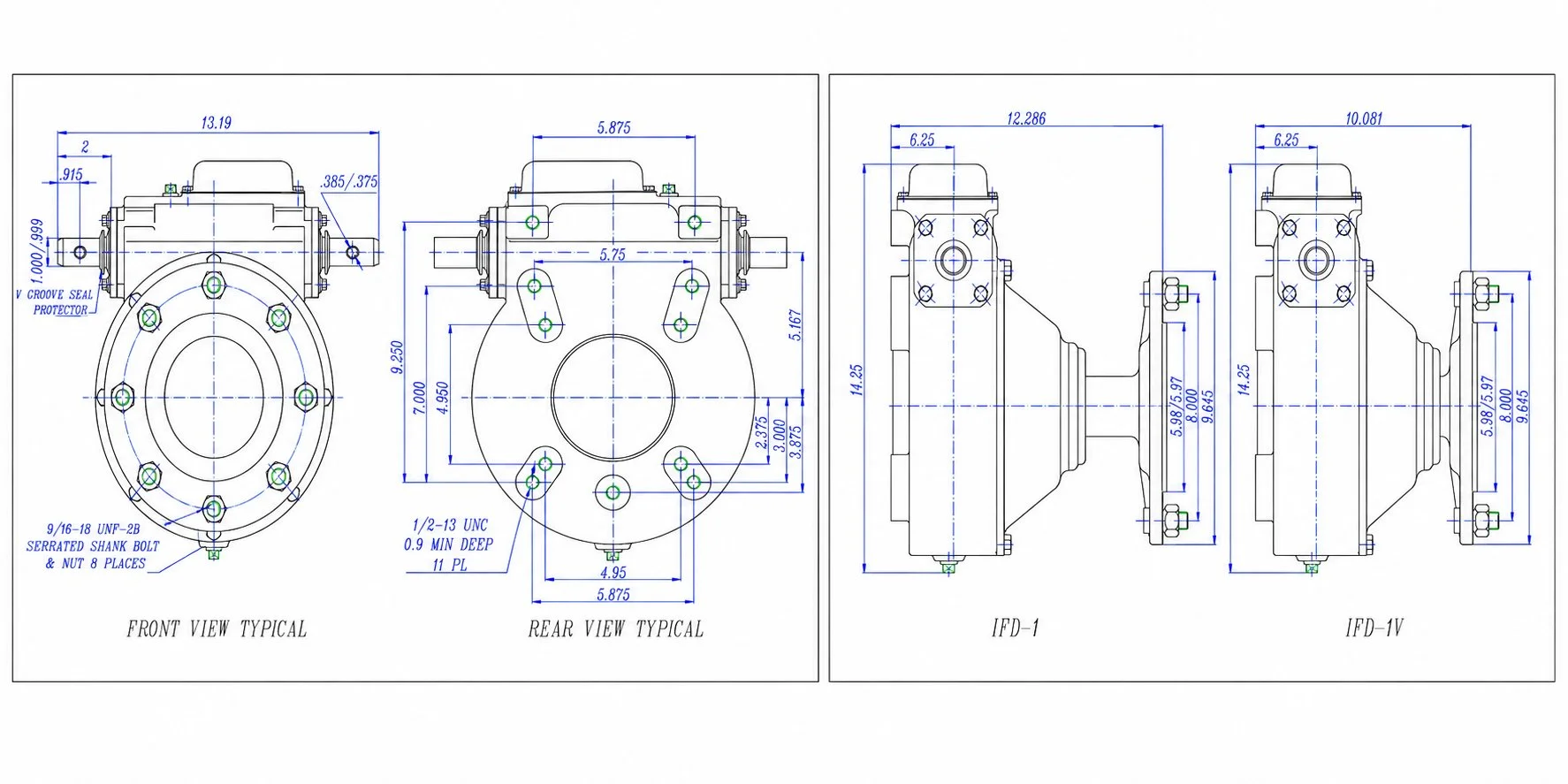
Dimensional reference for standard irrigation wheel-drive gearbox mounting configurations
Continuous-Duty Thermal Management
Worm gearboxes generate more heat per kilowatt of transmitted power than any other gear type because the worm-wheel contact is predominantly sliding rather than rolling. In an irrigation gearbox running continuously at 40–60% efficiency, 40–60% of the input power is converted to heat inside the housing. A 1 kW motor driving a 50% efficient worm gearbox generates approximately 500 watts of continuous heat that must be dissipated through the housing surface into the ambient air.
In temperate climates, natural convection from the housing surface is usually sufficient — the large surface area of a cast iron housing radiates heat effectively, and even light air movement from the pivot’s rotation provides additional cooling. In hot climates (ambient temperatures above 35 °C), the equilibrium oil temperature inside the gearbox can exceed 90 °C during continuous daytime operation, approaching the thermal limit of standard mineral gear oil. At these temperatures, oil oxidation accelerates, viscosity drops, and the protective film at the worm-wheel contact becomes dangerously thin.
Solutions for hot-climate irrigation include synthetic gear oils with higher thermal stability (PAO-based synthetics maintain film strength to 120 °C and beyond), finned housing designs that increase the convective surface area by 30–50%, and duty-cycle management that limits continuous operation during peak afternoon heat. Some premium systems use aluminum housings with integral cooling fins, which dissipate heat 2.5× faster per unit area than cast iron — though aluminum’s lower strength requires thicker wall sections in areas subject to wheel reaction forces.
Corrosion Protection and Shaft Sealing in Wet Environments
An irrigation gearbox operates in a permanently wet environment. The output shaft passes through a seal into an area that is regularly submerged during field crossings through muddy ruts, standing water, and spray drift from the overhead sprinklers. Unlike a PTO gearbox on a seasonal implement that encounters moisture occasionally, an irrigation gearbox is wet every operating day for the entire irrigation season — often five or more continuous months.
Water intrusion through the output shaft seal is the single leading cause of irrigation gearbox failure. Water in the gear oil causes rust on the worm wheel bronze surface, etching of the worm shaft bearing races, and emulsification that destroys the oil’s load-carrying capacity. Effective sealing requires a multi-barrier approach: a primary double-lip shaft seal (FKM material for chemical resistance to fertilizer-laden water), a secondary external slinger or V-ring that deflects standing water away from the primary seal face, and a filtered breather vent positioned high on the housing — above the maximum possible water submersion line — to equalize internal pressure without admitting water.
Housing corrosion from chemigated water (irrigation water mixed with liquid fertilizer or pesticide) is another failure mode specific to irrigation gearboxes. Unprotected cast iron surfaces corrode rapidly when exposed to nitrogen-based fertilizer solutions. Quality irrigation gearboxes use either epoxy-coated cast iron housings or fully painted exterior surfaces with corrosion-inhibiting primer. Stainless steel fasteners prevent the bolt head corrosion and seizure that makes future service access difficult or impossible.
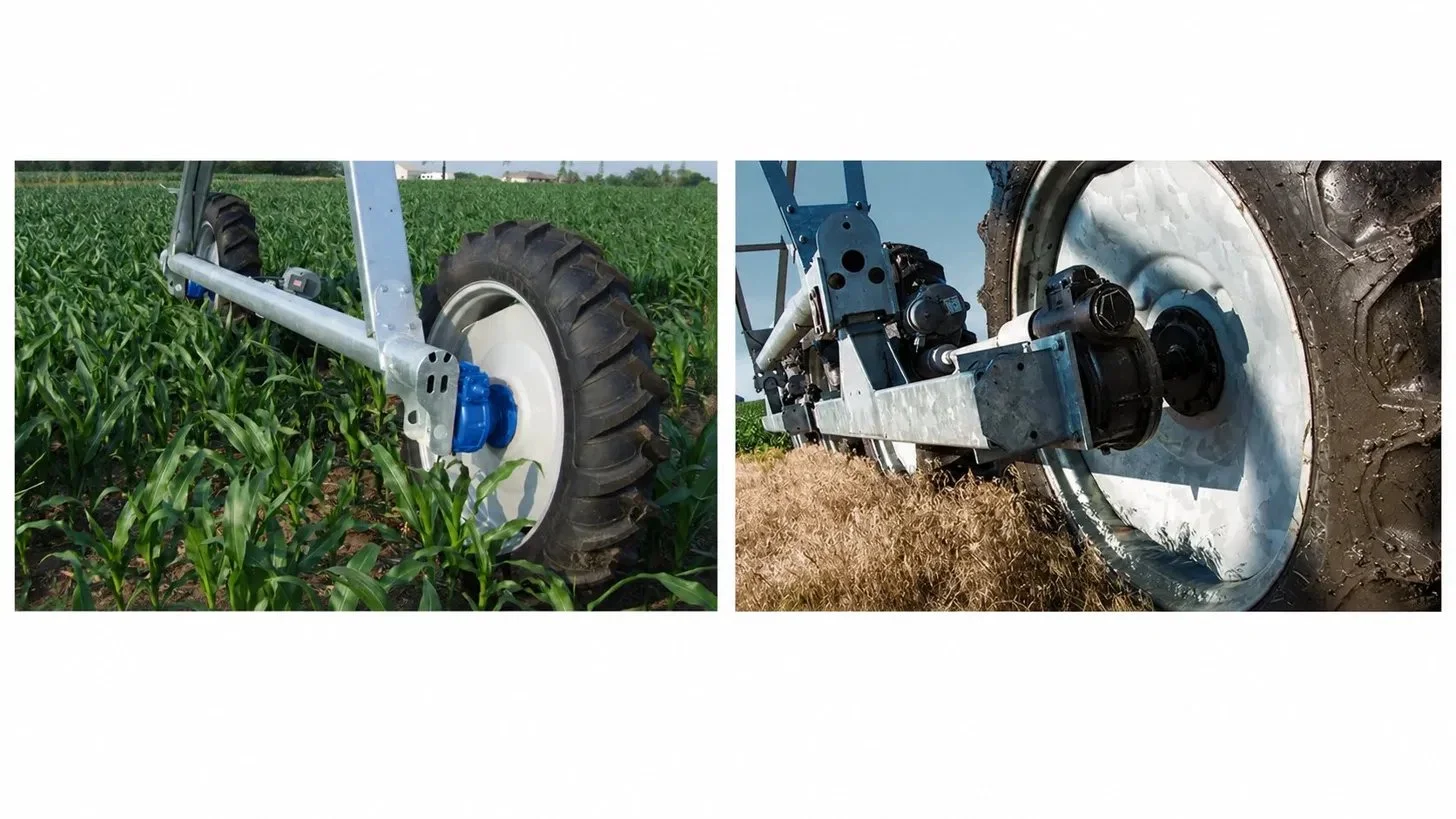
Center-Pivot vs. Lateral-Move: Gearbox Differences
Center-pivot systems dominate the irrigation market, but lateral-move (linear) systems serve rectangular fields that a circular pivot cannot fully cover. From a gearbox engineering perspective, the two systems impose different demands despite using similar tower-drive hardware. In a center-pivot, the outermost tower travels the farthest distance and runs the most hours, while the inner towers cycle on and off to maintain alignment. In a lateral-move system, all towers travel the same distance simultaneously, meaning every gearbox accumulates identical operating hours per pass. This uniform duty cycle actually simplifies gearbox maintenance scheduling — every unit reaches its service interval at the same time — but it also means that any gearbox sizing error affects every tower equally rather than being limited to the outermost spans.
Lateral-move systems also require the gearbox and drive motor to reverse direction at each end of the field, which introduces a loading condition that center-pivot gearboxes rarely experience. The reversal momentarily unloads the worm contact, allows backlash to close from the opposite side, and then reloads in the reverse direction. Over thousands of reversals per season, this bidirectional loading accelerates wear on the worm wheel teeth if the gearbox was originally designed for unidirectional rotation only. When specifying gearboxes for lateral-move irrigation, confirm that the manufacturer rates the unit for bidirectional service and that the worm wheel tooth profile is symmetric — some worm gearboxes optimize the tooth contact pattern for one direction of rotation and wear significantly faster when run in reverse.
Guidance systems on lateral-move irrigation — whether GPS-guided or furrow-following — add another reliability consideration. If the guidance fails and the system drifts off course, the end towers may encounter field boundaries, fence lines, or drainage structures that create sudden mechanical resistance. The irrigation gearbox must withstand these abnormal stall-load conditions without stripping the worm wheel teeth. A properly sized gearbox handles the stall torque, but a marginally specified unit — common when purchasers select the cheapest option meeting the nominal speed and torque spec — may not survive the first guidance fault. This is another reason to specify irrigation gearboxes with a minimum 25% torque margin above the calculated worst-case operating load.
Specification Table: Irrigation Gearbox Selection Parameters
| Parameter | Small Pivot (≤200 m) | Standard Pivot (200–400 m) | Large Pivot (400+ m) |
|---|---|---|---|
| Motor power per tower | 0.37 kW | 0.75 kW | 1.1–1.5 kW |
| Gear type | Single-stage worm | Worm or helical-worm | Helical-worm or planetary |
| Ratio | 40:1 to 50:1 | 50:1 to 55:1 | 50:1 to 60:1 |
| Output torque | 150–250 N·m | 250–400 N·m | 400–650+ N·m |
| Output speed | 0.5–2 RPM | 0.5–2 RPM | 0.5–2.5 RPM |
| Seal type | Double-lip FKM | Double-lip FKM + slinger | Double-lip FKM + slinger + V-ring |
| Design life target | 10,000+ hours | 15,000+ hours | 20,000+ hours |
If you are specifying irrigation gearboxes for a new pivot installation or replacing worn units on existing systems, contact our engineering team with your tower weight, wheel size, field slope, soil conditions, and motor specifications. We cross-reference mounting patterns and confirm torque compatibility before any unit ships.
Maintenance Schedule for Irrigation Gearboxes
Irrigation gearboxes accumulate operating hours rapidly — a pivot running 16 hours per day for 150 days logs 2,400 hours per season. This high utilization demands a maintenance discipline scaled to irrigation duty, not the occasional-use schedule applied to seasonal agricultural gearbox applications like mowing or baling.
🛢️ Irrigation Gearbox Maintenance Intervals
●
Pre-season — Drain old oil, flush housing, refill with fresh gear oil. Check output shaft seal for hardening or cracking. Measure gear backlash. Verify motor coupling alignment.
●
Every 500 hours (monthly during peak season) — Check oil level and color. If milky, drain and replace immediately. Clean breather vent. Inspect output shaft area for leak signs. Check mounting bolt torque.
●
Every 2,000 hours (end of season) — Full oil change. Inspect worm wheel tooth surface for pitting or excessive wear pattern. Check bearing play. Clean and recoat any corroded housing surfaces. Seal all openings for off-season storage.
●
Every 5,000–8,000 hours — Replace output shaft seals regardless of visible condition. Internal worm wheel inspection for bronze wear. Bearing replacement if play exceeds manufacturer tolerance.
The single most effective maintenance action for extending irrigation gearbox life is oil quality management. A worm gear running in clean, correctly graded oil with no water contamination will reach its designed bronze-tooth life of 15,000–20,000 hours. The same worm gear running in contaminated oil may fail in 3,000–5,000 hours. The cost of two oil changes per season is negligible compared to the cost of a mid-season gearbox replacement on a tower that is impossible to reach with heavy equipment during irrigation.
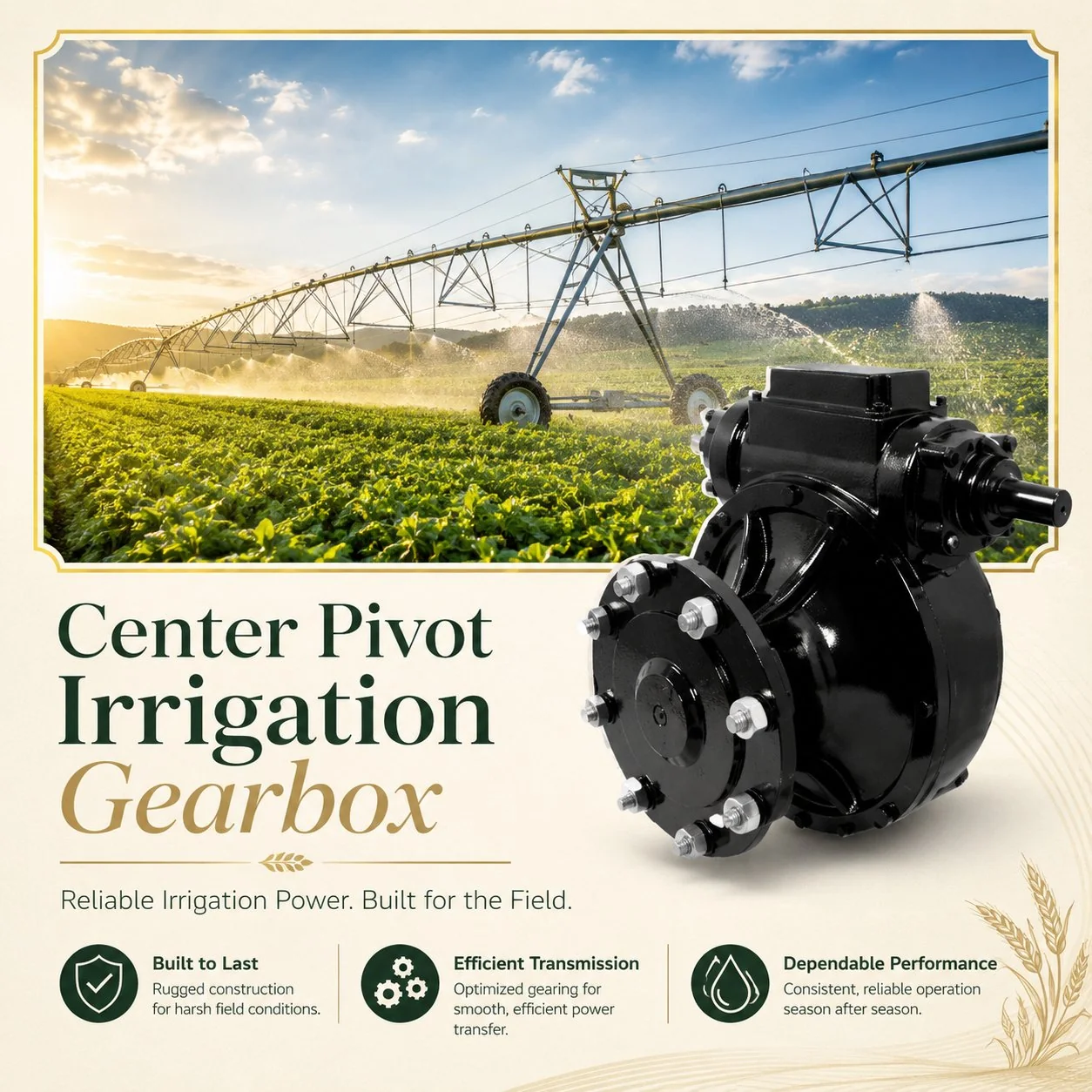
Cross-Brand Replacement Compatibility
Center-pivot irrigation systems from major manufacturers — Valley, Zimmatic (Lindsay), Reinke, T-L, and Bauer — all use tower-drive gearboxes that follow similar mounting conventions but differ in specific bolt patterns, shaft dimensions, and ratio selections. Aftermarket replacement gearboxes manufactured to the dimensional specifications of these OEM units provide a cost-effective alternative to dealer-sourced originals, often with improved seal technology and corrosion protection that extends service life beyond the original equipment. All brand names referenced are registered trademarks of their respective owners and are mentioned solely for cross-reference identification.
When cross-referencing a replacement, confirm the mounting bolt pattern (typically 4-bolt on a square pattern), motor input shaft diameter and keyway, output shaft diameter and spline count (if applicable), gear ratio, and rotation direction. Many aftermarket suppliers including Ever-Power PTO Gearbox maintain cross-reference databases that map OEM part numbers to compatible aftermarket units — supply the OEM number and we verify all critical dimensions before shipping.
For PTO-driven irrigation pumps that use a PTO shaft and speed increaser to drive a centrifugal pump directly from the tractor, the same dimensional cross-referencing applies. The key parameters are PTO input speed (540 or 1000 RPM), speed increaser ratio, pump input shaft diameter, and the gearbox’s continuous thermal rating at the target pump flow rate. Undersizing the gearbox for a continuous-duty pump application is one of the most common specification errors in PTO-driven irrigation — a gearbox rated for intermittent duty on a rotary cutter will overheat and fail within weeks when driving a pump for 12 hours per day.
Frequently Asked Questions
Need Expert Gearbox Engineering Support?
From single tower-drive replacements to complete pivot system gearbox supply programs, our agricultural gearbox engineering team delivers precision irrigation gearbox solutions — backed by cross-reference verification and 100% factory load testing on every unit.
Editor: Cxm