Reading a Failed Gearbox: The Forensic Approach
When a PTO gearbox fails in the field, the natural response is to replace it and resume work as quickly as possible. But replacing a gearbox without understanding why it failed guarantees repeating the same failure on the replacement unit. The failed gearbox contains all the evidence needed to identify the root cause — if you know what to look for.
Each failure mode leaves a distinctive signature on the gears, bearings, seals, and oil. Pitting looks different from scoring. Bearing seizure produces different debris than gear tooth fracture. Oil degradation from heat looks different from oil contamination from water. Learning to read these signatures turns every failed gearbox into a diagnostic opportunity that prevents the next failure.
The following eight failure modes are presented in approximate order of frequency across all agricultural gearbox applications — from the most common (oil degradation and seal failure) to the less common but often catastrophic (thermal runaway and housing fracture).
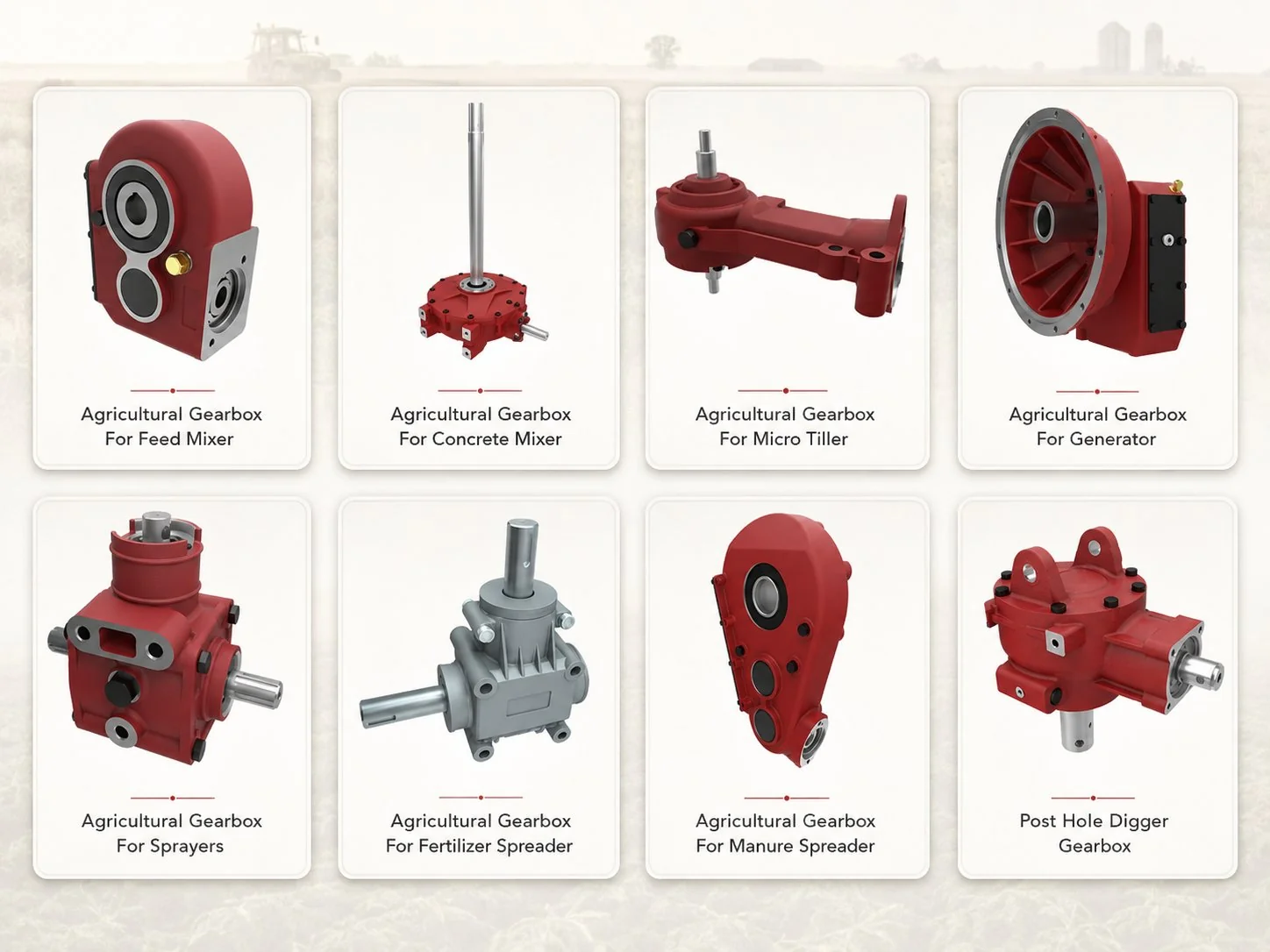
1. Oil Degradation — The Silent Killer
Oil degradation is the most common root cause of gearbox failure across all implement types, and it is almost always the result of neglected maintenance rather than an engineering deficiency. Gear oil degrades through three mechanisms: thermal breakdown (sustained high temperatures crack the oil’s molecular chains, reducing viscosity and EP additive effectiveness), oxidation (exposure to air through the breather vent gradually depletes antioxidant additives), and contamination (water, dust, or wear particles alter the oil’s chemistry and physical properties).
The forensic signature of oil degradation is visible at disassembly: gear teeth show uniform surface discoloration (a dark, varnish-like stain), bearing raceways have a matte, etched appearance instead of the original polished finish, and the oil itself is dark brown to black with a burnt odor. If the magnetic drain plug shows an even coating of fine metallic silt rather than discrete particles, the wear pattern is consistent with inadequate lubrication from degraded oil rather than a specific component failure.
Prevention
Change oil at the manufacturer’s specified interval — never extend it. Use the correct specification (EP GL-5, 80W-90). For continuous-duty applications, consider synthetic oil for its superior thermal stability. Monitor oil condition monthly during the operating season and change early if the oil darkens significantly or develops an unusual odor.
2. Seal Blow-Out — Pressure Without Relief
A seal “blow-out” — where the seal lip is pushed away from the shaft or the seal body is extruded from its bore — is almost never caused by a defective seal. It is caused by excessive internal pressure that the breather vent failed to relieve. During operation, gear oil heats and expands, increasing the gas pressure inside the sealed housing. A functioning breather vent allows this expanding air to escape. A clogged breather traps the pressure, which builds until it exceeds the seal’s retention force — and the weakest seal blows.
The forensic signature is a seal that appears to have been pushed out of its seat. The seal lip may be deformed outward, or the seal body may be partially extruded from the housing bore. The housing bore itself should be undamaged — if the bore shows scoring or erosion, the root cause may be corrosion or improper installation rather than pressure. Check the breather vent immediately: if it is packed with dust, dirt, or oil residue, you have found the root cause.
Once a seal blows, the gearbox rapidly loses oil while simultaneously ingesting contaminants from the field environment. If the operator does not notice immediately, the gearbox can progress from seal failure to bearing seizure within a single operating session.
3. Gear Tooth Pitting — Fatigue Under the Surface
Pitting is a surface fatigue phenomenon where small craters form on the gear tooth contact face. It occurs when the contact stress between meshing teeth exceeds the surface fatigue strength of the gear material — repeatedly. Each load cycle propagates microscopic cracks just below the hardened surface. When a crack network reaches critical size, a small piece of the surface breaks away, leaving a pit.
Initial pitting (sometimes called “corrective pitting”) can actually be benign — it redistributes load across the tooth face, and if the oil is clean and the load is within design limits, the pitting stabilizes. Progressive pitting, however, indicates the gearbox is overloaded for its design capacity or the oil has degraded to the point where the EP film can no longer protect the tooth surfaces at the contact pressure they experience.
The forensic distinction matters: if pitting is uniform across all teeth and both gears, the cause is systemic (oil condition, load magnitude). If pitting is concentrated on specific teeth or one side of the tooth face, the cause is misalignment or manufacturing defects in gear geometry.
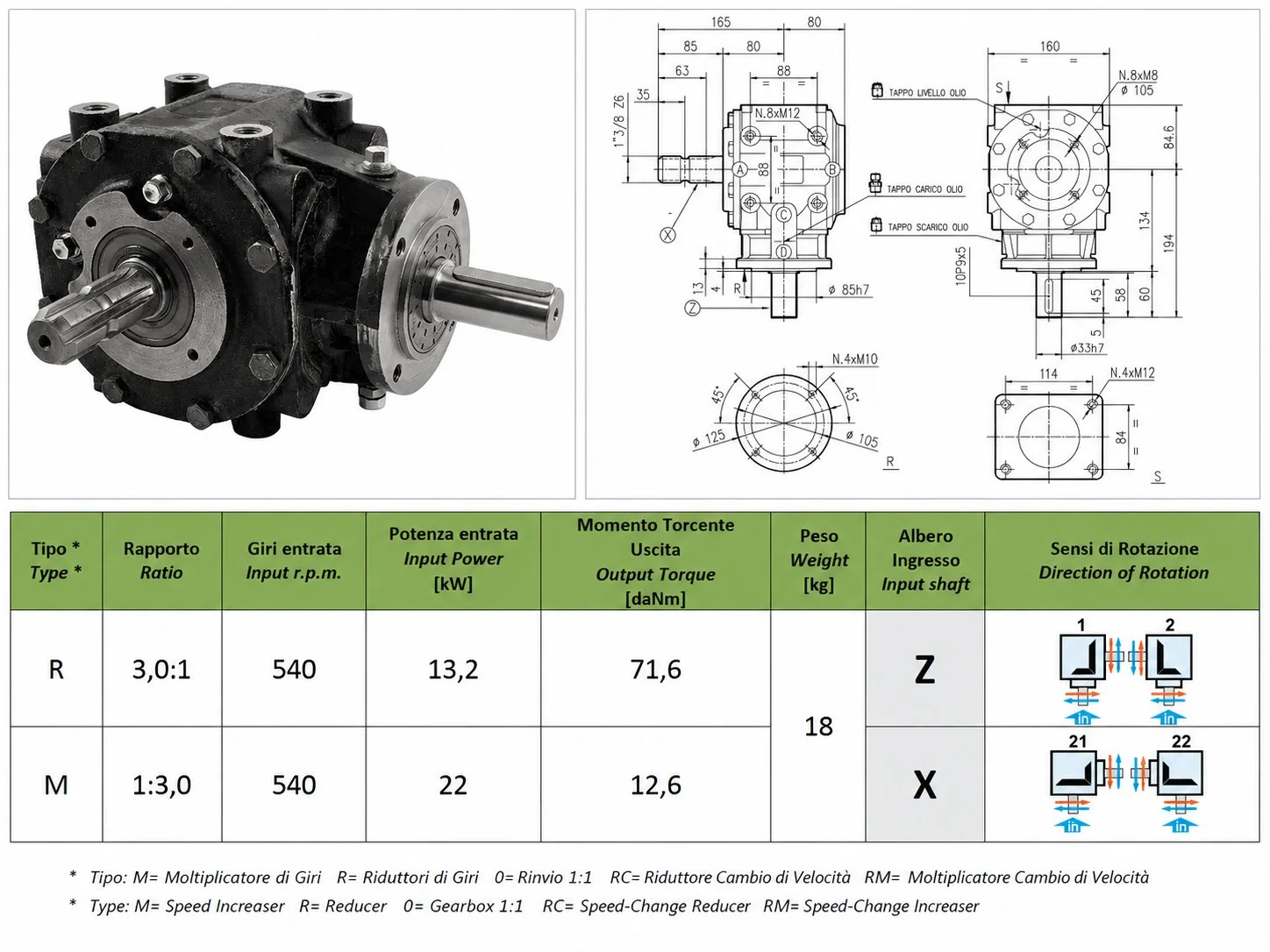
Gearbox dimensional drawing — gear mesh alignment and bearing arrangement determine load distribution on tooth surfaces
4. Spline Wear — The Driveline Connection Point
The spline connection between the PTO shaft and the gearbox input is a sliding fit under torque — a demanding combination. Without regular greasing, the spline teeth wear through a mechanism called fretting corrosion: microscopic movements under load oxidize the contact surfaces, and the oxide particles act as an abrasive between the spline teeth, accelerating wear in a self-reinforcing cycle.
Worn splines develop excessive backlash (free play before torque transmits), which creates impact loading at every PTO engagement and every torque reversal during implement operation. This impact loading accelerates wear on both the spline and the gearbox input bearing, creating a cascade where a driveline maintenance issue eventually destroys internal gearbox components.
Inspect by grasping the PTO shaft yoke and the gearbox input shaft separately and rocking them in opposite rotational directions. Any perceptible free play indicates wear beyond the design clearance. Replace the worn component — continuing to operate with spline backlash transfers the impact loading from an inexpensive driveline component into the expensive gearbox internals.
5. Bearing Seizure — The Catastrophic Endpoint
Bearing seizure is rarely the primary failure — it is the final stage of a cascade that started with lubrication failure, contamination, or overloading. The progression follows a consistent pattern: bearing surface begins to spall (fatigue pitting on the raceway), spall debris circulates in the oil, debris damages additional bearing surfaces and gear teeth, friction increases, heat increases, oil film breaks down locally, metal-to-metal contact generates welding heat, and the bearing locks solid.
The most common trigger for bearing seizure in agricultural gearboxes is water contamination. Water enters through failed seals or breathers, mixes with gear oil, and attacks the precision-finished bearing surfaces through hydrogen embrittlement and corrosion pitting. Bearing life in water-contaminated oil drops by 50–80% compared to clean oil — a bearing designed for 5,000 hours may fail in 500–1,000 hours with just 0.1% water content.
When a bearing seizes during operation, the consequences depend on the bearing’s position. An output bearing seizure locks the implement — the gearbox stops and the tractor’s PTO overload device (shear bolt or clutch) activates. An input bearing seizure may allow the gearbox to continue running briefly with the bearing welded to the shaft, generating extreme heat and potentially cracking the housing before the operator notices. In either case, the internal damage is usually severe enough to require complete gearbox replacement.
6. Housing Crack — Fatigue at the Stress Riser
Cast iron gearbox housings crack at predictable locations: mounting bolt holes, bearing bore transitions, and the split-line flange between housing halves. These locations are geometric stress risers — points where the cross-section changes abruptly, concentrating cyclic stress from vibration and torque reaction forces.
The forensic signature of a fatigue crack is a clean fracture surface with visible “beach marks” — concentric rings radiating from the crack origin point, showing the progressive growth of the crack over thousands of load cycles. The final fracture zone, where the crack grew large enough that the remaining cross-section could no longer carry the load, shows a rougher, granular surface.
Housing cracks are most common on tillers and flail mowers — implements with high-frequency vibration that excites resonance in the housing structure. Loose mounting bolts amplify the problem: the housing flexes against the mounting surface with each vibration cycle, concentrating fatigue stress at the bolt hole. Regular torque checks on mounting bolts are one of the most effective preventive measures against housing fatigue fracture.
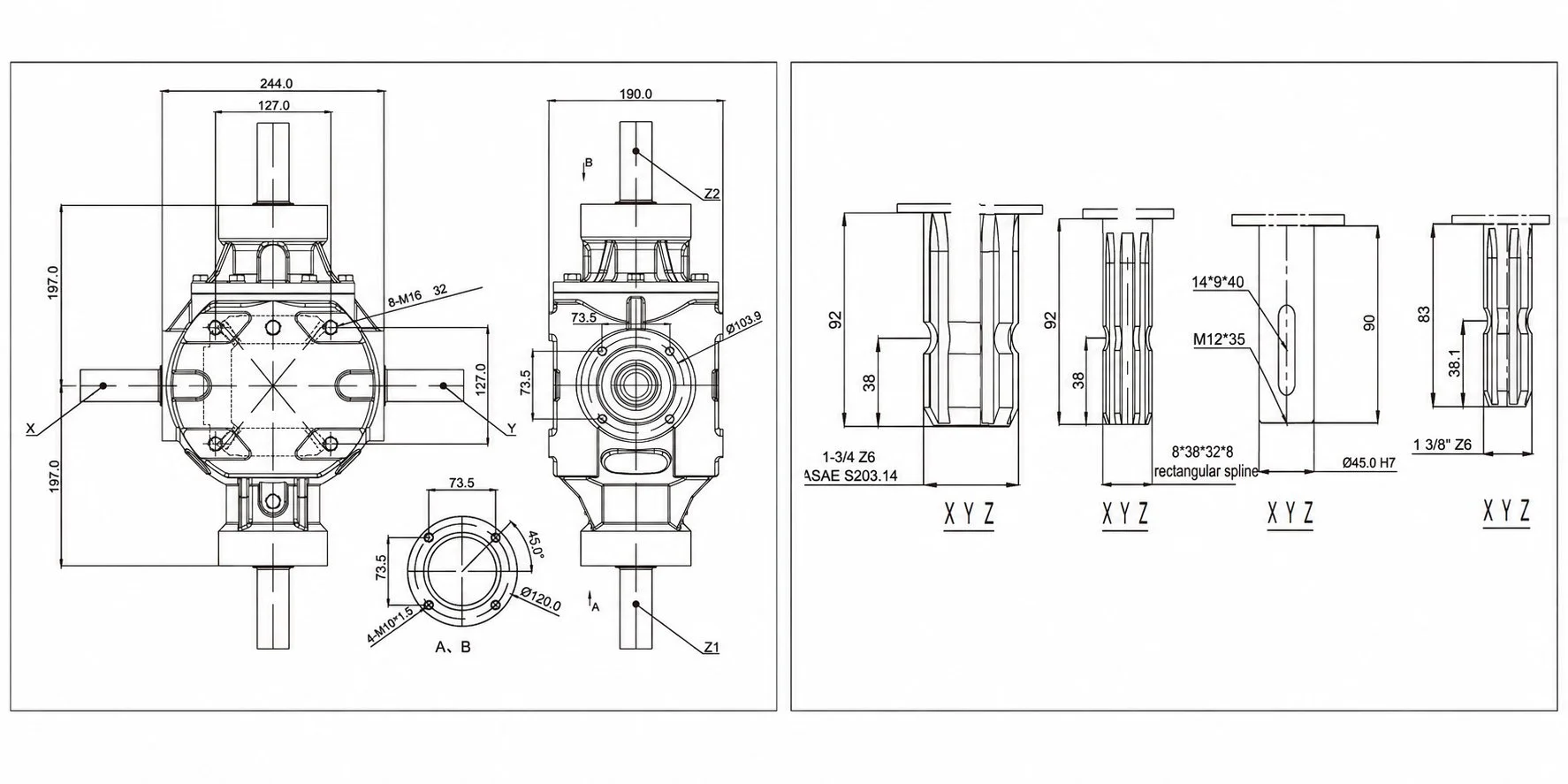
7. Input Shaft Fatigue Fracture
The input shaft carries the full PTO torque into the gearbox and simultaneously absorbs bending loads from the driveline connection. Fatigue fracture occurs when the cyclic bending stress exceeds the shaft material’s endurance limit — the stress level below which the material can withstand infinite load cycles.
The most common cause of input shaft fatigue is driveline misalignment — the PTO driveline running at excessive operating angles. Every revolution at a misaligned angle creates a bending stress cycle on the input shaft. At 540 RPM, that is 540 stress cycles per minute, 32,400 per hour. In a single 200-hour season, the shaft accumulates over 6 million fatigue cycles. If the bending stress from misalignment exceeds the endurance limit, the shaft will crack and eventually fracture.
Prevention requires maintaining PTO driveline alignment within the manufacturer’s specified operating angle (typically below 15 degrees, with both U-joints at equal angles). Verify alignment with the implement in its working position, not just in transport — the operating position often creates different driveline geometry than the transport position.
8. Thermal Runaway — When Heat Exceeds Dissipation
Thermal runaway is the rarest but most catastrophic failure mode. It occurs when heat generation inside the gearbox exceeds the housing’s ability to dissipate it — the temperature climbs progressively, oil viscosity drops, load-bearing film thins, friction increases (generating more heat), and the cycle accelerates until components reach destructive temperatures.
The conditions that trigger thermal runaway include: gearbox severely undersized for the application (continuous operation at or above rated capacity with no margin), low oil level leaving gear mesh and bearings partially starved (friction generates more heat with less oil to carry it away), clogged breather vent trapping hot air (reducing convective cooling inside the housing), and extreme ambient temperature combined with sustained full-load operation.
The forensic evidence is dramatic: oil is thin, dark, and smells burned; gear teeth and bearing surfaces show heat discoloration (blue or straw-colored tempering marks); seals are hardened and brittle; and in severe cases, bearing cages have melted or deformed. A gearbox that has experienced thermal runaway is not rebuildable — the heat has altered the metallurgy of every hardened component inside the housing.
Field Investigation Methodology: How to Read a Failed Gearbox
Before disassembling a failed gearbox, document the external evidence. Photograph the seal areas, the breather vent condition, the mounting bolt state (are any loose, missing, or stretched?), and any external cracks or damage. Drain the oil into a clean, white container — this single sample contains more diagnostic information than any other source. Note the oil color, odor, clarity, and any visible particles or water droplets on the surface.
During disassembly, observe the sequence carefully. Note which bearing failed first (the most damaged bearing initiated the cascade; others show secondary damage from circulating debris). Examine gear teeth under strong side-lighting — pitting, scoring, and wear patterns are far more visible under angled illumination than under direct overhead light. Use a magnet to distinguish ferrous debris (gear and bearing steel) from non-ferrous debris (bearing cage material, seal fragments), as each points to a different failure origin.
The most valuable diagnostic technique is matching the physical evidence to the operating history. A gearbox that failed at the start of the season after sitting idle for six months probably suffered storage-related corrosion that weakened bearings. A gearbox that ran fine for 200 hours and then failed suddenly experienced an acute event — an impact, a sudden overload, or an abrupt loss of lubrication. A gearbox that deteriorated gradually over 1,000+ hours experienced chronic wear from marginal lubrication quality, slight overloading, or progressive contamination.
This investigative discipline transforms reactive maintenance (replacing broken parts) into predictive prevention (addressing the systemic conditions that cause breakage). Every failure that is properly diagnosed and its root cause corrected represents one fewer failure across the entire implement fleet — because the same maintenance gaps that killed one gearbox are likely present on every other unit in the same operation.
Failure Mode Quick Reference
| Failure Mode | Primary Root Cause | #1 Prevention Action |
|---|---|---|
| Oil degradation | Missed oil changes | Change on schedule, use correct spec |
| Seal blow-out | Clogged breather vent | Clean breather monthly |
| Gear tooth pitting | Overloading or oil degradation | Size gearbox correctly, maintain oil |
| Spline wear | Lack of grease on PTO spline | Grease spline at every connection |
| Bearing seizure | Water contamination | Maintain seals, check oil clarity |
| Housing crack | Vibration + loose mounting bolts | Torque-check mounting bolts regularly |
| Input shaft fracture | Driveline misalignment | Verify PTO angle in working position |
| Thermal runaway | Undersized gearbox or low oil | Size with 125%+ margin, maintain level |
Frequently Asked Questions
Replace with Confidence — Every Failure Prevented
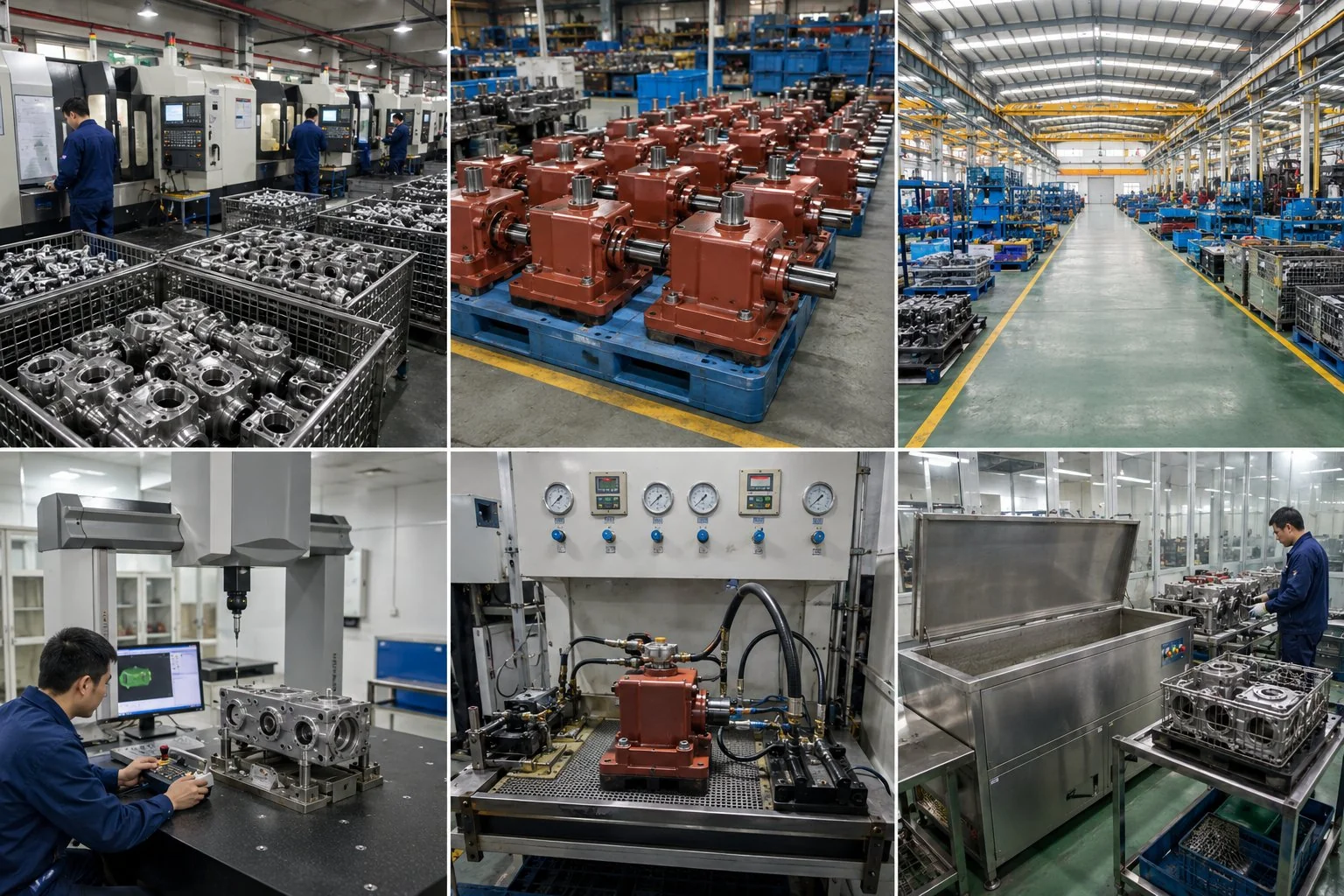
Ever-Power manufactures agricultural gearbox replacements engineered to address every failure mode in this guide — carburized gears, named-brand bearings, FKM seals, serviceable breather vents, and magnetic drain plugs as standard.
Editor: Cxm